
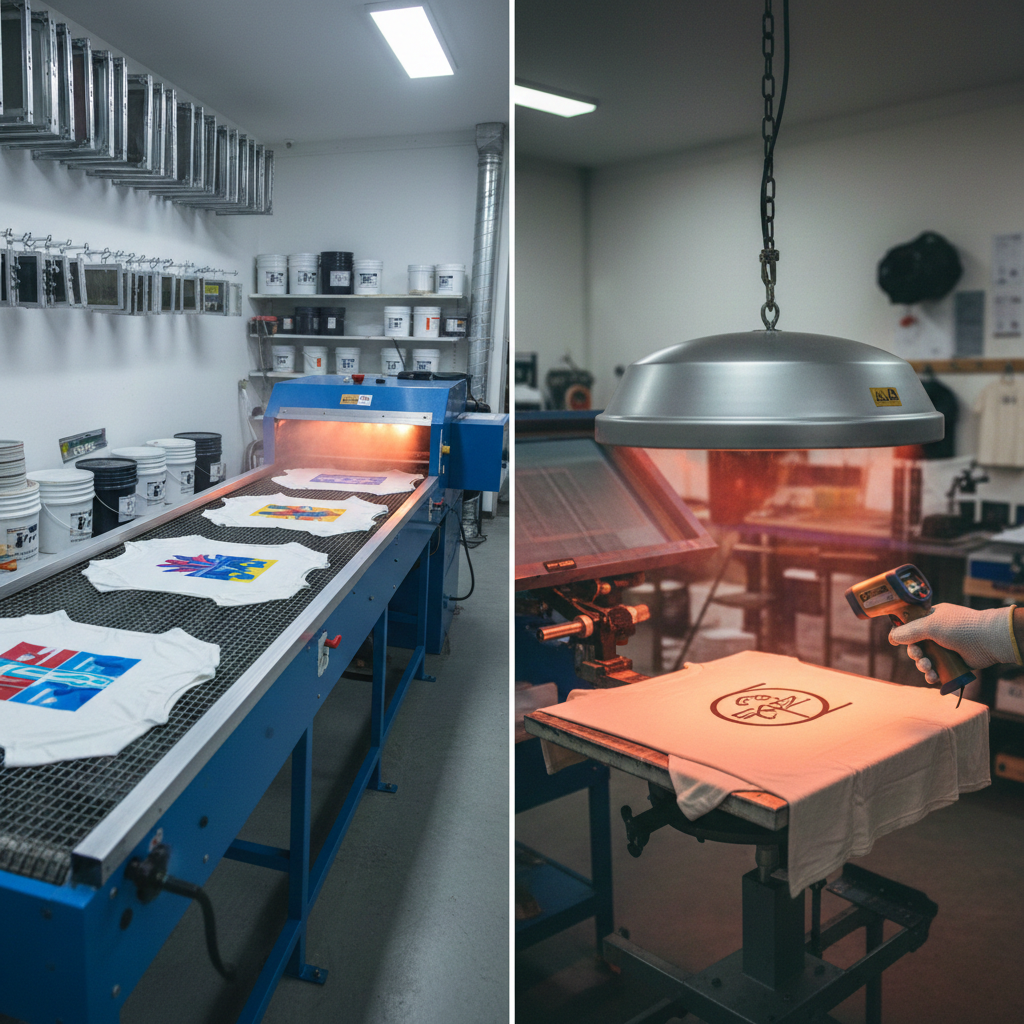

Curing is where good prints become great—or where they quietly fail weeks later. Whether you’re running a full auto or a small manual setup, the choice between a conveyor dryer and a flash dryer has a real impact on consistency, production speed, and garment feel.
There’s no one-size-fits-all answer. Here’s a practical breakdown of both options—and how choosing the right blank helps either method perform better.
Conveyor Dryer: Built for Consistency
A conveyor dryer is the gold standard for full curing, especially on production runs.
Pros
- Even, all-over heat for consistent cures
- Ideal for plastisol and water-based inks
- Scales well for longer runs
- Reduces under-cure risk when dialed in
Cons
- Higher upfront investment
- Takes floor space and ventilation
- Over-curing can affect hand feel on softer garments if not monitored
Conveyors shine when paired with garments that can handle consistent heat without losing their intended look and feel.
Flash Dryer: Flexible but Demanding
Flash dryers are most often used between print strokes—but many shops rely on them for full curing on smaller runs.
Pros
- Lower cost and minimal footprint
- Useful for spot curing and quick jobs
- Ideal for startups and limited space
Cons
- Less uniform heat distribution
- Easy to over-flash the surface while under-curing underneath
- Slower and more labor-intensive for full cures
Flashing requires a closer eye and a garment that reacts predictably to heat.
Why Garment Choice Matters More Than You Think
Heat doesn’t just cure ink—it affects the fabric’s appearance and hand feel. Softer, ring-spun garments can scorch, stiffen, or lose their character if curing isn’t controlled.
That’s where Style 2100 – Retro Ring-Spun T-Shirt fits perfectly into the conversation.
Designed as a midweight, vintage-style tee with a soft ring-spun cotton feel and timeless fit, the 2100 performs well with either curing method when properly dialed in.
Why printers like the 2100 for curing flexibility:
- Ring-spun softness that still holds up under consistent heat
- Balanced fabric weight that cures evenly without feeling overbaked
- Vintage-inspired hand feel that stays intact after curing
- Reliable results with both conveyor and flash setups
When your garment responds predictably to heat, dialing in cure temperatures becomes easier—and repeatable.
Choosing the Right Cure Method for the Job
Ask yourself:
- Are you running long production jobs or short custom runs?
- Do you need speed or flexibility?
- How sensitive is the garment’s hand feel to heat?
For premium-feel tees like the Retro Ring-Spun 2100, consistency matters just as much as cure temperature. Starting with a stable, print-friendly blank helps protect the finished product.
Final Takeaway
Conveyor dryers deliver consistency. Flash dryers deliver flexibility. Both can produce great results—if your garment is up to the task.
With its soft ring-spun feel and classic profile, the Retro Ring-Spun 2100 gives printers confidence that their cure process won’t compromise the final look or feel. That’s a win for the shop and the client.
Share:
How to Charge for Printing Mistakes Without Losing Clients
Why White Ink Is Always the Problem Child (and How to Tame It)