
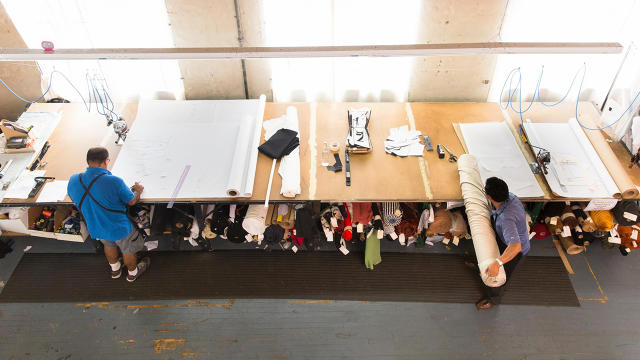
How Global Warming Is Already Changing the Fashion Industry
It wasn't just you. The entire fashion world felt the impact of a warm winter. Here's what they're doing about it.
While some politicians continue to deny climate change, fashion retailers are already feeling the burn of a warming winter climate.
Talking to Co.Design, a Patagonia spokesperson called climate change "a serious crisis" for its business. And while retailers like J.Crew, H&M, and Nordstrom declined to comment, the numbers speak for themselves. Uniqlo, H&M and Gap all announced major seasonal shortfalls that year, and Macy's was cutting more than 4,500 jobs following sluggish holiday sales, blaming much of its revenue shortfall on cold-weather goods like jackets, hats, and scarves that did not sell.

"People don't want to talk about anything that's a problem," says Valerie Steele, director and chief curator of The Museum at the Fashion Institute of Technology, "because it indicates maybe they're not doing as great as they think they should be."
Yet there are experts in the fashion industry who are already adapting, and who spoke openly about how climate change is transforming their business models, their designs, and the very notion of seasonal fashion itself. Here's how.
Clothing That's Ordered Late, and Shipped Even Later
It's a perfectly common practice for winter fashion to hit shelves in July. This lead time is the final step in a larger logistical operation: heavy pieces may have hit catwalks and started the journey to production anywhere from 6 to 18 months before they arrive in a store.
And yet, for all this planning, nobody buys a winter coat in the sweltering days of summer, and some brands are beginning to question the long lead time.
"Typically the way the industry is set up is a little odd, where you sell sweaters in July in anticipation of September. It becomes this game of racing to get a fresh product a little too early, I've always thought," says Yael Aflalo, founder and CEO of fast U.S. fashion brand Reformation. "Most people go to get sweaters when it's cold outside. I don't buy sweaters in July. I buy sweaters when it's cold, and, oh my god, I need sweaters!"
Instead, Aflalo built her business on limited-run clothing, produced only four to six weeks before it reaches shelves. As warm weather stuck around, the company's short production pace paid off and allowed it to reassess how much winter stock it really needed. "We had our offering of fall stock, and had to scale back what our purchases were for cold weather, and shift to seasonless items," she says. "We were able to react and it wasn't that detrimental, but it still leaves a gap. A certain amount of sales in outerwear or sweaters, they were just reduced."

In other cases, retailers capitalized on delays that had summer items arriving in fall. Rebecca Minkoff admits that her business got a lucky break when a delay pushed a suede jacket from a July ship date into October and November. "But that timing was perfect," she says, because the midweight jacket matched 2015's warm fall.
To anyone outside the fashion industry, the idea of garments produced during the season in which they'll be worn seems obvious, especially when it's tough to know what weather the next season will bring. That is why Minkoff changed the timing of its seasonal shows, running consumer-facing runway shows closer to actual ship dates.
Traditionally, designers show their fall line in February, seven to eight months before anyone will wear it. Minkoff started showing spring in February, about a month before the season begins. "More and more people are shipping in season," Minkoff says. "That's why we started to show in season." As a bonus, tighter show-to-ship dates reduce what she calls image fatigue, when customers get bored of a fashion line long before they can buy it.
Not every retailer can change its schedule. Larger retailers need to learn how to juggle inventory across regions. If a city is colder than expected, they need systems for moving cold-weather goo
Share:
The Zuckerberg Charcoal Uniform
Factoring a Factoring Company into Your Business